ABOUT
EDUCATION
PROGRAMS
LIBRARY
PUBLICATIONS
THEORY
Please wait while the policy is loaded. If it does not load, please click here to view the policy.

Re: Indicating the body portion involvement of a turn
In Ann Hutchinson Guest’s January 10 posting she says that in Motif Notation a blank turn sign (shown here in 1a) indicates a turn of the body-as-a-whole, and a turn sign containing a hold sign (shown here in 1b) indicates a turn of a body part. .
Ann does not say how to indicate a generic turn in which body portion involvement is unspecified or irrelevant. I feel a blank indication, as in 1a, should be used for the generic indication. Pre-signs should be used to show if the turn is done by the whole body (1c), an unspecified body part (1d), or a specific body part (1e). (For a detailed discussion of this issue, see my June 5, 2001 posting in the Motif Symposium thread.)
As I see it, the hold sign in a turn sign (1b) indicates a twist; it does not say anything about body portion involvement.

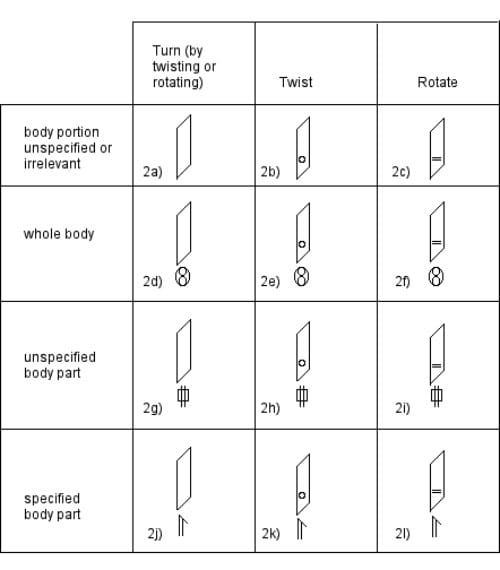
My idea for indicating the various possibilities is summarized below.
Ex. 2a) Turn (twist or rotate) the whole body or a body part (i.e., body portion involvement is unspecified or irrelevant).
Ex. 2b) Twist the whole body or a body part (i.e., body portion involvement is unspecified or irrelevant).
Ex. 2c) Rotate the whole body or a body part (i.e., body portion involvement is unspecified or irrelevant).
Ex. 2d) Turn (twist or rotate) the whole body.
Ex. 2e) Twist the whole body.
Ex. 2f) Rotate the whole body.
Ex. 2g) Turn (twist or rotate) an unspecified body part.
Ex. 2h) Twist an unspecified body part.
Ex. 2i) Rotate an unspecified body part.
Ex. 2j) Turn (twist or rotate) a specific body part (the arm).
Ex. 2k) Twist a specific body part (the arm).
Ex. 2l) Rotate a specific body part (the arm).
Re: Pre-signs
In 2g-i above, an “unspecified body part” is indicated with a pre-sign comprised of the sign for “area” and the sign for “limb.” The pre-sign for “whole body” in 2d-f was discussed previously in the Body Parts thread (Guest and Hackney, November 15, 2001; Wile, November 15, 2001).
In Ann Guest’s January 10 posting in the Body Parts thread, a plain square is used to indicate an [unspecified] area of the body (see the pre-sign in Ann’s example 1c, shown here in 3a). Is this the same as the sign for “any body area” shown here in 3b? If so, I prefer 3b.

Re: Indicating gestural paths
In Motif Notation the hold sign on a path indication shows that the path is traced by a body part. For instance, 4a indicates a path drawn by an unspecified body part. In Ann Guest’s January 10 posting she says that this leads some people to want the hold sign on indications which state a body portion, as shown here in 4b and 4c. In my opinion, body part pre-signs make the hold signs in 4b and 4c redundant and unnecessary. I am in favor of eliminating the hold sign on all gestural path indications. For instance, 4d would indicate a gestural path traced by an unspecified body part; 4e and 4f would indicate the paths in which a body portion is stated.
