ABOUT
EDUCATION
PROGRAMS
LIBRARY
PUBLICATIONS
THEORY
Please wait while the policy is loaded. If it does not load, please click here to view the policy.

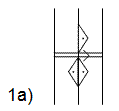
2.12 Rose Anne said it is not a step because it has a caret. The caret tells you that you do not release your foot, so you are doing a shift of weight, not a step.
2.13 Charlotte said the caret by itself does not tell us that the movement is a shift of weight rather than a step. Rather, according to the definition Ray gave, 1a is not a step because it involves a partial shift of weight. [Addendum from Charlotte: See the example 1p in Par. 2.81 below. That example also has a caret that says “do not release the foot.” However, in that careted example the movement is a step, not a shift of weight. Why? Because the movement involves a full transference of weight.]
2.14 Sandra: The meaning of the terms is well established. There is no need for this discussion.
2.15 Charlotte disagreed. She reiterated that the BB exchange (Par. 2.2 above) showed that even notation experts may not be in agreement about the meaning of the terms. Consequently they had difficulty communicating. As individuals we may say to ourselves, “I have the definition of what a step is,” and then assume that everyone else has that same definition. However, then, as has happened many times at these meetings, we are surprised to discover that we are not all in agreement.
2.16 Sandra said she does not feel that the words used to describe the movement are important. Everyone is in agreement with the meaning of the symbols, and that is what matters. Dance isn’t about words, it’s about movement.
2.17 Ray strongly disagreed. He said that when you notate you need to be able to first put the movement into words in order to capture it well in symbols.
2.18 Sandra said that she never puts the movement into words first. She always translates directly from the movement to symbols.
2.19 Lynne agreed with Sandra and gave an analogy with learning to speak a language. When a person who speaks English is learning to speak French, at first he may translate concepts into English and then translate them into French. But at a certain point he is able to translate the concepts directly into French.
2.20 Rose Anne said she tells her students that at a certain point in their studies, maybe in Intermediate notation, they will be able to stop thinking and translate the movement directly into symbols. The LN language becomes the language you are operating in.
2.21 Ray said words can be important when movement examples are not available. For example, someone might by trying to learn notation by reading about it in a book. When verbal explanations in LN texts are unclear or contradictory, it can be extremely confusing.
2.22 Oona: Some people learn fastest by listening to the words that are used to describe the movement.
2.23 Charlotte said again the BB posting (Par. 2.2. above) exemplified how problematic it can be when terms are given different meanings.
2.24 Mira said that the problem arose when Lucy used the word “step.” People where not sure if she meant a partial or a full transference of weight. This then led to confusion in the discussion.
2.25 Oona said that the committee that met to discuss the Elementary exam found that terms like “shift of weight” often were confusing for students.
2.26 Charlotte: In considering the definition of the terms, we should take into account how they are used in everyday parlance. Terms in LN do not always have the same meaning in everyday language.
2.27 Charlotte brought up an idea Ray had discussed with her. The word “shift” has different meanings in LN. When it is used with supports, i.e., a “shift of weight,” it refers to weight transference. However, in a shift of a body area it is given a very different meaning. There it denotes movement in which the two ends of the given body portion are displaced an equal amount.
2.28 Sandra: The words are not confusing because they are always used in context.
2.29 Charlotte: The words “step” and “shift” have different connotations within LN, as well as in everyday language. One way to address this issue is to avoid those words in explaining notation rules. Instead, the rules could use terms that more accurately describe what happens in the movement. For example, for supports one could say there is a partial weight transference or a full weight transference. These two terms would cover all the possible variations and would make one know clearly what the movement is about.
2.30 Sandra: Does that mean we could never use words like stepping and walking?
2.31 Ray: No! Words like stepping and walking could still be used. It just would mean that the terms “full weight transference” and “partial weight transference” would be used to explain the meaning of symbols.
2.32 Rose Anne and Sandra continued to feel that the meaning of the terms “step” and “weight shift” are understood by everyone and do not need further clarification.
2.33 Ray: If that were true, then the discussion in the BB posting would never have taken place. Everybody would have understood from the beginning what Lucy meant when she used those words.
2.34 Lynne: The English language is what is causing the problem.
2.35 Charlotte: The issue is not that one set of words is necessarily better than another. What is important is that we need to be in agreement about the meaning of whatever words we use. If one person says a step is one thing, and another is giving the term another meaning, and they aren’t even aware that they are using the word differently, then they will not be able to communicate.
2.36 Lynne: The meaning of words change and evolve over time. Therefore, we cannot give them a specific meaning.
2.37 Charlotte argued that, to the extent that it is possible, we need to have a standardized meaning for notation terms. For example, in everyday language the word “diagonal” just means an oblique angle. Consider a position in which one arm is side high and the other arm is side low. In some disciplines, such as Bartenieff Fundamentals, this is called a “diagonal” position. [See Irmgard Bartenieff and Dori Lewis, Body Movement: Coping with the Environment, page 255.] However, as we know, that would not be considered a diagonal position in LN. We have given the word diagonal a different meaning and we all agree on that meaning. Without that standardized meaning in the system there would be great confusion.
2.38 Lynne agreed that to the extent that we can, it is helpful to give our terms a clear meaning, even if it is not possible to pin everything down exactly.
2.39 Charlotte agreed that it is not possible to pin down every term exactly, e.g., terms for Effort and dynamics are very difficult to define.
2.40 Ray said that another word in LN that creates problems is “tilt.” In Guest, Labanotation, it says that a tilt means you go “away from the vertical.” In other words, if the torso begins place high, and then it goes forward high, that is a tilt. However, if the torso begins forward middle and then goes forward high or place high, would that be considered a tilt?
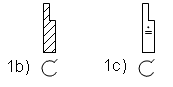
2.41 Charlotte: In LN the meaning of the word “tilt” can be understood in contrast to the word “shift.” In a tilt of a body area, one end of the body area is displaced more than the other end. This is indicted with the appropriate body part pre-sign followed by a basic direction sign, as in 1b. In a shift, both ends are displaced equally. This is indicated with the appropriate pre-sign followed by a direction sign that contains an equal sign (1c). According to this analysis, a body area that begins forward and then goes forward high is a tilt. This seems awkward because in everyday language we don’t use the word tilt in that way.
2.42 Lynne used the image of a cow lowering its head to see how in everyday language one might use the word tilt. Everyone laughed when Ray jokingly said the answer to that is, “Moo.”
2.43 Charlotte: Here again, perhaps we could find a better term for what we now call “tilt”. For instance, maybe such movements might be referred to as movements with unequal displacement. “Shifts” of the body parts could then be referred to as movements with equal displacement.
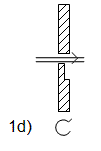
2.44 Some people in the group did not feel that Ex. 1d should be called a tilt.
2.45 Sandra looked the word tilt up in the dictionary, but the definitions there did not seem to help the discussion.
2.46 As in the discussion of the words “step” and “shift,” Sandra and Rose Anne felt there was no problem with the word tilt because we are all in agreement about the meaning of the symbols.
2.47 Charlotte felt that calling 1b a tilt, but saying that 1d is not a tilt, is confusing. We analyze them in the same way. They are both movements of a body area in which one end is displaced more that another. We indicate them in the same way, with a pre-sign followed by a direction sign. Therefore, it would be clearer in our explanation of the symbols if we use a term that fits both movements.
2.48 Ray: In Guest, Labanotation, 4th edition, page 228, it says, “Tilting, also called inclining or ‘taking a direction’, means movement of a part of the body away from its normal position into another direction.”
2.49 Sandra repeated that even if we take umbrage with the words in the text, that does not cause problems with our understanding the notation. Any new terms that one would come up with would also cause confusion.
2.50 Rose Anne said that she has never had a problem when she uses the word tilt to teach notation.
2.51 Charlotte felt that may be true in certain situations, but not in others. Words invoke certain movement ideas. For example, she has found in teaching children notation or teaching notation at LIMS, a word like “tilt” can cause confusion because it connotes something different in everyday language.
2.52 Sandra said that the teacher in those situations then has the responsibility to teach the meaning that the word has in LN. Students need to learn the meaning of the words in the context in which they are being used.
2.53 Charlotte: In teaching the difference between 1b and 1c I might in passing use the vernaculars “tilt” and “shift.” However, to explain the movements I would emphasize the fundamental difference between them: there is unequal displacement in one and equal displacement in the other. This gets to the heart of the salient difference between those two categories of movement.
2.54 Rose Anne: In a tilt of the torso you assume that the body is going off the vertical away from normal.
2.55 Charlotte: If my arm is place high, is that normal? No. So in that case I am giving a different meaning to the word tilt from what you are saying it means in a tilt of the torso.
2.56 Sandra: The arm doesn’t “tilt.”
2.57 [Addendum from Charlotte: In Guest, Labanotation, 4th ed., page 228, it says, “Although the term tilting is not used for arms, gestures of the whole arm in one piece that take a new direction, are comparable to tilts in that they employ the some basic kind of action.”]
2.58 Rose Anne: The rules and terms for actions of different body parts should be different. The body parts operate differently in our physicality.
2.59 Sandra: The torso cannot do the same movements as limbs, so they require different terms.
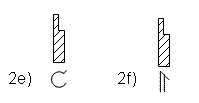
2.60 Charlotte held that the analysis and the way we indicate 1e and 1f are the same. Wouldn’t it be clearer to use the same terms in describing that analysis?
2.61 Charlotte suggested that categorizing all body portions going in a direction as moving with either equal or unequal displacement can open up new ways of perceiving and indicating movement. For instance, we have a way of indicating that a body area moves with equal displacement (which in the texts is called a shift, as in 1c above). Why can’t that analysis be applied to limbs or parts of a limb? For example, in this movement [Charlotte demonstrated movement that is depicted here in drawings 1g and 1h] the ends of the lower arm moves with equal displacement. [This could be indicated as in 1i and 1j.]
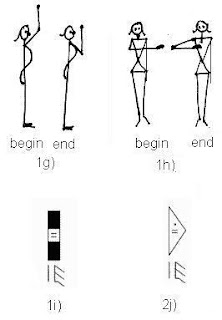
2.62 Sandra emphatically said no to this idea. As she sees it, the lower arm cannot shift. The arm cannot move independently from the rest of the arm, so it cannot shift. In contrast, the head can shift independently from the rest of the body.
2.63 Ray and Charlotte: If the definition of a shift of a body area is that both ends of the part move an equal amount, then that analysis can be applied to limb parts [as in 1g-1j]. The analysis underlying the two movements is the same.
2.64 Rose Anne returned to the term “tilt.” The definition of a tilt of the head is that the free end moves away from the fixed end.
2.65 Ray: That is just one example of the movement category we are discussing. However if you look at all the movements which fit into the definition we are discussing, then all have the same analysis: a movement in which the free end moves more than the fixed end.
2.66 Sandra: Does Ann give notation examples in the text for these other movements?
2.67 Ray: No. And that is part of the problem.
2.68 Sandra: Then how do you know that Ann is not just using different terms for the same concept.
2.69 Ray: She is. She gives three different names for the same concept, the same analysis. The problem is that those different names conjure up different images, which makes one think that they represent different concepts.
2.70 Sandra: Maybe the solution is to eliminate definitions rather than changing the terminology.
2.71 Charlotte returned to the idea of categorizing direction indications into two categories: those that represent movements with equal displacement and those that represent movements with unequal displacement. She has found that thinking about direction in this way can open up new ways to perceive movement. The idea of moving limbs or limb parts as a block [as in 1g,h] is just one example. Another is equal displacement for the whole body, as in the whole body going forward in ice skating. In other words, the body-as-a-whole moves with the top of the head and the base of the body moving the same amount.
2.72 Sandra continued to feel that a movements such as 1g and 1h are completely different from a head shift. In her analysis, the lower arm is not moving. Rather, the action is happening in the upper arm, and this causes the lower arm to change is position.
2.73 Charlotte: Yes, that is one way to perceive and write the movement. But another way to think about the movement is to focus on the movement of the lower arm moving as a piece in space, rather than thinking of it as the result of the movement of the upper arm. There are many ways that the movement can be written. The different methods or recording the movement each express a different intent.
2.74 Sandra said we already have a ways to write the movements, e.g., 1k. The method of writing that Charlotte is proposing is not needed. [1k is a photo of what Sandra drew at the meeting.]
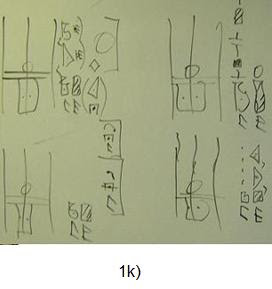
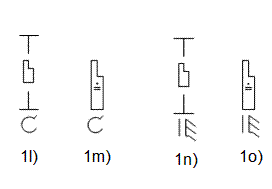
2.75 Charlotte said Sandra’s examples show only some ways to indicate the movement. The focus in Sandra’s examples is on moving the upper arm with the lower arm following. However, they do not express the intent of moving the lower arm as a piece. As an analogy, the head movement in 1l and 1m may produce the same movement, but the intent is different. If we need these two ways of indicating these two intents for the head, why not have both intents for limbs, [e.g. 1n, 1o]?
2.76 Sandra said that what Charlotte is proposing is interesting in theory, but in the real word it has no practical use. Choreographers never talk about the lower arm moving with the intent Charlotte is describing.
2.77 Charlotte said that if she were teaching children to do the movement in 1g, she might say move your lower arm “up and down”. This gives them a very different idea of how to think of the movement than if she said “move your elbow in a path,” or move your upper arm and carry your lower arm with it.” As another example, in William Forsythe’s DVD “Improvisation Technologies” he sometimes focuses on having limb parts go somewhere as a block.
2.78 Charlotte: Exploring new ways of capturing intent expands our perception of movement. For example, the development of design drawing opened up new ways of seeing and experiencing movement.
2.79 Ray: We are going into new areas that we don’t have answers for. We should not say that a new idea isn’t needed because no one has done it in the past. We need to keep our minds open. Maybe we will discover the idea doesn’t work. But we need to at least consider it. When one person has a need for the new symbols or terms, then that should be explored. Often then other people may pick up on that idea and also find it useful. If we do not feel free to present and explore these new ideas, we may miss out on something. That is how the whole system develops.
2.80 Sandra continued to feel that Charlotte’s proposal is not a good idea. She said Charlotte’s ideas will create conflicts in the system because they will change the established ways of perceiving and writing. The idea of moving the limb [as in 1g and 1h] is completely different from shifting a body area. The limb movement needs to have a completely new terminology and indications.
2.81 Addendum: Mei, Mira, and Charlotte discussed the terms “step” and “weight shift” further after the meeting. They realized that they indeed did have different definitions of the terms “step” and “weight shift.” (See Par. 2.11-2.15 above). For instance, at first Mei and Mira said that 1p is a weight shift, and 1q is a step. Charlotte said that both movements are steps. Must the gesturing leg release first release from the ground in order for the movement to be considered a step? After further discussion, all three decided that that this was not a consideration. They all agreed that “step” and “weight transference” could be defined as follows:
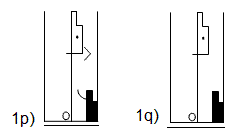
2.82 A step is a full weight transference of weight from one foot to the other. In other words, the movement must begin with all the weight on one foot, and end with all the weight on the other foot. Using this definition, both 1p and 1q are steps. Whether or not the touching gesturing leg in 1p releases before the weight transference is not relevant.
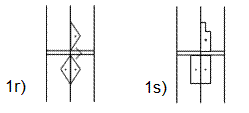
2.83 In a weight shift there is only a partial transference of weight. For instance, since the weight in 1r begins with weight on the right foot as well as the left foot, the movement to the right foot is only a partial transference of weight. Therefore, this movement should be considered a weight shift.
2.84 A movement such as 1s actually consists of a partial weight transference followed by a full weight transference. However, the partial weight transference is not written, and the movement taken as a whole is called a step.
3.1 TOPIC #3 – JIMMYLE LISTENBEE’S RESPONSE TO THE ICKL FELLOWS REPORT
3.2 Jimmyle Listenbee e-mailed an addendum concerning Tina Curran and Susan Gingrasso’s ICKL Motif Fellows report in the October 20, 2009 minutes.
Comments from Jimmyle Listenbee. Re: Susan Gingrasso’s ICKL Motif Fellows report in the October 20, 2009 minutes. Paragraph numbers refer to the Oct 20 minutes.
1.4 (2) I am very interested in helping develop dialogue among Laban-based motif users and participating in such a dialog.
1.5 Web-based is good. Active participation could be good screening criterion and also pro-active tool in developing dynamic, broad-based discourse.
1.7 History: Correction. The 2001 and 2004 Motif Symposiums at Columbus and Edwardsville were also co-sponsored by Motus Humanus.
1.10 From my perspective, the following is the crucial core of the proposal. I have highlighted key words in Susan & Tina’s text and in my comments below
Comment A: If CMA’s are to become truly active in the discourse, the spirit of active, creative, dynamic use of motif must be honored equally along with rigorous investigation of both similarities and differences among different traditions of usage and practice. It must not devolve to a question of “who is correct”; it must be an ongoing process of learning each other’s continually evolving languages.
1.10 Need/Rationale
Need: To create a recognized and ongoing space for discussions to occur related to the theory, pedagogy and application of Motif-no such forum currently exists that encompasses practitioners from the various Laban-based practices. See Comment A above.
Rationale for existence-some ideas to get us started.
– Involve constituents across the Laban community in a discussion about Motif Notation in and across applications; See Comment A above.
– Build a larger base from diverse constituents; See Comment A above.
– Cultivate international collaboration and community; Yes, especially through substantial multi-lingual semantic research.
– Develop dance literacy through entry of Motif and nurture growing knowledge within Laban Studies (LMA, LN, and LOD, etc.)
1.12 All these objectives are excellent and necessary.
1.13 Questions & my personal answers
(a) I worked very hard for many years to encourage such a group, and would be ecstatic if it came to be.
(b) Of course I want to participate! Have said so forever. Feel oppressed by one-sided, limited, defensive thinking, & competitive spirit of discussions dominated by Labanotation & LOD practitioners.
(c) I believe it would be useful to the world for everyone in the Laban community to realize that we share a common language in Motif
(d) My main questions are:
Are ICKL, LOD and the Labanotation community ready to welcome the changing, nuanced concepts/symbols of LMA (& Kestenberg, etc.) with open arms and a willingness to learn and include?
Is the CMA community ready to welcome the well-reasoned, consistent and concrete concepts/symbols of LOD & Labanotation with open arms and a willingness to learn and include?