ABOUT
EDUCATION
PROGRAMS
LIBRARY
PUBLICATIONS
THEORY
Please wait while the policy is loaded. If it does not load, please click here to view the policy.

[The following is reprinted from “Seeing, Doing and Writing Movement,” Proceedings of the Motus Humanus Advanced Seminar in conjunction with Motif Symposium II, July 15-18, 2004, Southern Illinois University Edwardsville, Edwardsville, Illinois. Jimmyle Listenbee, editor.]
Abstract
This paper will identify meter as a principle in the observation of movement. Meter is defined here as the measurement of duration with rhythm marked through the sequence of movements. I begin with distinctions between timeline and rhythm, and then demonstrate how Meter exists even with differing degrees of pulse regularity. Using brief taped examples of movement sequences, I will present ideas of meter as qualitative as well as quantitative through Motif Description as the means for identifying particular duration. Whether meter is formed during the course of performance, or exists as an entity external to a movement sequence, distinctive concepts of beginning/end, anacrusis/downbeat and accent will be discussed, drawing from past and current metrical theories in the field of music. Distinctions between Meter and Vera Maletic’s Phrase and Phrasing work will be presented.
(Kine)Meter: Metric Presence in the Context of Movement Observation
Once a lava lamp is warm, our attention is attracted to the movement within the tube. Using our skills of movement observation, we see the recurring cycle of up and down motion – but how is this reconciled with the dynamic shaping of the bubbles themselves? Is it actually repetitive cyclic motion, or is it a continual unfolding of new pattern? Regardless of how we choose to interpret our observation, the closed system of the lava lamp suggests the presence of Meter, a mechanism for measuring the events in the tube. This type of mechanism could be useful for Movement Observation.

Introduction
I traveled to China a couple of weeks ago; one among many wonderful experiences was the temporal challenge of crossing the international dateline. Going over, I lost a whole day – landing a day later than I when I left – Saturday for me didn’t exist. Coming home, though, I gained an extra day – I had two Sundays. This presentation focuses on our ability to functionally measure time in the context of experience.
Meter, in the Performing Arts, is often discussed in the context of musical performance and I will draw liberally from theories and conceptions of musical meter. But I want to lead to the prospect of Metrical presence in the context of Movement Observation.
Main Objective
My main objective is to expand the notion of METER as not only a predetermined and rigid measurement of time. METER, is perceived through recurrence, but is not necessarily a fixed and rigidly repeating recurrence.
Movement Observation is important to the craft of Dance Notation, with the use of notation symbols common to both. Dance Notation, historically, records details of compositional frameworks. A good dancer/mover, however, communicates the composition clearly. Interpretation of meaning in a fixed compositional work of art is different than the interpretational task for the Observer. A good Observer communicates meaning of the actual movement during the course of performance and uses notation as a tool. MOTIF, for example, is useful for quickly writing notes during observation.
For me, Movement Observation entails the objective categories of body, space, energy; shape and relationship. Our perception of the way these elements come together in a performance, is the stuff of OBSERVATION. There are many approaches to Method of Observation – as it should be – to be useful.
Observation begins with a focal purpose – the method is front-loaded, with ANALYSIS playing a key part of the purpose, an approach to analysis integral to its method. The ideal is not to see everything, but only those elements deemed important for meaningful contextual analysis and summary of movement.
The construct of Meter, or measurement, guides our perception of FORM. In the context of Observation, Meter could provide a construct for understanding the Formal BEHAVIOR of the Observed. METER measures. It offers insight and access to these various perceptions of Form.
What is Meter?
I contend that Meter is Fluid, formed in the course of performance. There may be prescriptive directions that help us OBSERVE an intended Metrical scheme, such as a repetitive swinging movement or 3/4 time signature. But in the realm of OBSERVATION, predictable schematics are not always maintained.
Meter in Context
To perceive METER in the context of Observation, we begin with a number of premises:
1. Meter is present in the rhythm of Movement
2. It is dependent upon performance.
3. Meter measures within the fluidness of rhythm.
4. Meter is formed by regular recurrence
5. Is determined by the Observer.
6. It is possible to determine a singular Meter in a work.
We can see repetitive, regularly recurring movements in this example of a European Round Dance. I think it clearly demonstrates these basic premises of Metric occurrence.
Quantity or Quality
We know that METER MEASURES, but is it measuring QUANTITIES or QUALITIES? Is it measuring the number of occurrences? Is it the QUANTITATIVE measurement of an occurrence – such as length of time or the degrees above or below par? Or the Qualitative measurement of an occurrence – such as how it happens, that matters? Or is it a combination of both Quantity and Quality?
INTERLUDE
I had a birthday earlier this week – my measured lifespan reaches into the 40’s. The card I received had a quote by Pamela Palmer pertaining to measurement: “Some measure days by dreams, and some by flowers.”
Timeline
A TIMELINE consists of a perceptual construct for events to flow through time. The Timeline denotes Pulses, defined by Beatpoints – instants that may or may not bear the aspect of quantitative durational time span – but exist nonetheless. It may be Natural, such as the seasons, or Intuitive, as with our breath. Or it may be Mechanical, such as a metronome, or Imposed by the consciousness: METER regulates those Timeline events.
EXAMPLE 3 (AUDIO) – “BLOW”, Miles Davis, trumpet
Concepts of Traditional Meter
At this juncture, it is relevant to provide a brief summary of the traditional elements of Meter that we are taught as performing artists:
(1) Meter comes from the Greek, METRON, and (organization) a musical composition into measures (from Webster’s Unabridged Dictionary.) French-mesure; German-Takt; Italian-tempo, mesura; Spanish-tiempo, compas (Harvard Dictionary of Music.)
The pattern in which a steady succession of rhythmic pulses is organized; also termed time. Western music is characterized by the regular recurrenceof such patterns. One complete pattern [or its equivalent in length] is termed a measure and in notation is enclosed between two bar lines.
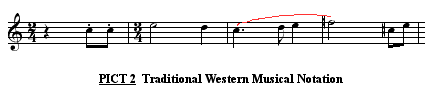
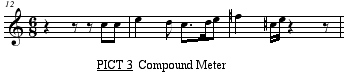
(2) Meters are indicated by a fraction with the denominator indicating the basic note-value of the pattern and the numerator indicates the number of such note-values making up the pattern. Meters are of two principle types – duple or triple. 2/4 and 3/4; 4/4 a special case of duple and 6/8, dividing basic duple into threes is considered as compound meter.

When observing, multiple components are taking our focus. Body, Space, Energy + sound/music. There is a built in counterpoint, making a single METER, as we describe in Western conceptual terms, difficult to determine.
Cycle vs. Recurrence
Up to this point, I have suggested that Meter, as we define it, has some limitations. Meter may be more than a fixed function. In the traditional definition, Meter is formed by “regular recurrences.” Cycle is one manifestation of recurrence.
There exist multiple synchronous simultaneous cycles in Indonesian Gamelan, revealing,
1) a concept other than a singular measuring of pattern, and
2) this measuring is not hierarchical.
What we learn from this suggests that Meter is not rigid – because while Gamelan cycles are pre-determined as composition, there is not ONE fixed Meter – there are many Meters working together. It is not Western Meter at all – it is Cyclic construction.I am suggesting today that our traditional notions of Meter not trap us. But before we move to discard elements from the traditional Western textbook definition presented earlier, let’s use it to determine what is essential to Meter:
1. timeline/pulse
2. recurrence of pattern
3. notation with barlines
4. calibration/denominator
5. organization of components
6. types of metrical structure
7. Accent
Accent
ACCENT is a study in itself. Here are some thoughts on Accent related to Meter:
1. Early history the accent in Musical performance referred to ornamentation; types of gestures physical and breath (Harvard-accent) e.g. of hand and weight; of movement of air/embouchure.
2. Arsis-Thesis; [exertion/rebound]
arsis – unaccented syllable; lifting of the foot; weak unaccented part of musical measure;
thesis – act of placing, laying down; downbeat of the foot; accented part of the musical measure;
thesis – lowering of the voice; act of placing lighter unstressed shorter part of a poetic foot in Accentual verse;
arsis – act of placing heavier stressed shorter part of a poetic foot in Accentual verse.
(This difference is noteworthy, especially in relation to discussion of energy, dynamics and effort. Is Force exertion against gravity or giving in to gravity?)
3, Developed ways to mark Accent: Ann Guest LOD concepts; par, above and below, accent (show examples)
4. Accent is defined differently by different Music Theorists. The following is a sampling of definitions from “Rhythm and Meter, A Glossary of Terms” (http://www.music.indiana.edu):
a. Grosvenor Cooper and Leonard Meyer (1960) define accent as “a stimuli (in a series of stimuli) which is marked for consciousness in some way.”
b. Fred Lerdahl and Ray Jackendoff (1983) define three kinds of accent, a) metrical, which denotes a beat (a time point) that is relatively strong in its metrical context, b) phenomenal, a surface emphasis or stress given to a moment in the musical flow, and c) structural, denoting an accent caused by melodic/harmonic points of gravity in a phrase or section, especially a cadence.
c. Wallace Berry (1976) defines accent as a combination of various musical qualities — strong as opposed to weak, high as opposed to low, etc. Accent is a metrical stress created by any of these qualities singly or in combination.
d. William E. Benjamin (1984) discusses three types of accent in his article ‘A Theory of Musical Meter.’ These accents are an accent of climax, an accent of image shift, and an accent of discontinuity.
(Note that the contextual function of Accent is integral to the definition of Accent.)
Additive and Divisive Metric Schemes
Metrical schemes can be thought of as being constructed by two regulating principles:
1. Division of a unit; or
2. Sequential Addition of units.
Curt Sachs, in his book Rhythm and Tempo (p.24), notes that Western musicians have measured time and tempo by normal walking STRIDES, an actual unit of motion. By this DIVISIVE conception, a series of beats equal distance apart is organized in patterns of 2 – e.g. 2/4. A method of Choral conducting in Britain, still used today by conductors of the Kings College Choir, is the two-part up/down or down/up arm motion marking the TACTUS, or beat. There is disagreement on whether the practice was up/down or down/up, more importantly, neither motion was emphasized, only the two parts of the beat (Sachs, p.217). DIVISION applied further to the rhythm of movement, yields preparation-exertion-recuperation from a unit of motion. A simple measuring of tension and relaxation leads to a notion of Divisive metrical measurement.
Another metrical concept is that of English Poetic Meter, with stress and unstressed syllables. Here, a UNIT is a FOOT. Lines, or phrases, consist of ADDITION of Metrical feet – e.g. monometer, hexameter.
2-syllable feet: Iambic, Trochaic, Spondaic
3-syllable feet: Anapestic, Dactylic
There may be varying Meters within a line of poetry:

– While this line is written primarily in dactylic hexameter – a trochee replaces the last dactyl (from Webster’s Unabridged Dictionary.)
Once again, it may not be possible to determine a singular Meter in a work.
Application to Laban Effort Phrase
Additive Process is found also in Laban Effort Phrasing. Effort factors combine into states and drives, viewed in sequence create Effort Phrases. Vera Maletic has outlined how Accent works to form basic types of Effort phrases (e.g.) Impactive, with the accent towards the end, or an Accent induced Impulsive phrase. But Accent is not inherently present in an isolated Effort configuration such as Punch (strong, quick, direct), instead, dominance of particular elements, factors, states or drives become apparent when seen in Relation to one another. The MANNER by which they shift between them is noteworthy for understanding Effort Phrase. [e.g. the work of Warren Lamb or Marion North].
How is Accent different between Phrase and Meter? ACCENT is identified in phrasing, but in relation to the formation of an expressive entity. At the start, or middle or end as a method of codifying meaning and intention. Accent defines metrical Occurrence, a regular recurrence of similar or varied pattern. If viewed in this way, the difference, I believe, is that phrase relates to the formation of an expressive entity, with a beginning-middle-end; a Progression forming a narrative. Where the Accent comes, beg-mid-end, is a method form codifying Phrase type. A Phrase has its own meaning, a metaphor.
METER, by distinction, MEASURES. It does not inherently express.
What is the difference, then, between Meter and Phrasing?
Phrasing is imbedded in style and performance practice, nuanced through the personality of the performer (Lamb). METER, as I propose here, is based on the context of ACTION, of PERFORMANCE, and is determined by the OBSERVER. Meter is the result of EXPRESSION; not the maker of expression.
Summary Statement:
Phrasing is the grouping of units, not the measurement of those units.
Metric Beginnings: Meter as Relationship
Mensural notation
A method of metric measurement dating back to latter 13th century, Franco of Cologne (Harvard Dictionary of Music, p. 544) made use of three main note values: long, breve and semibreve and through a system of sequential juxtapositions called Ligatures. The relationship between any two adjacent note values can either be duple or triple.
An Italian system takes the breve as a starting point and divides it at three successive levels – either by two or by three.
The term ‘Perfect’ refers to measuring of three and ‘Imperfect’ to that of two.
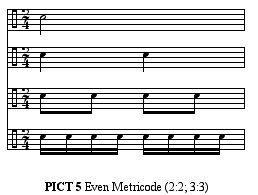
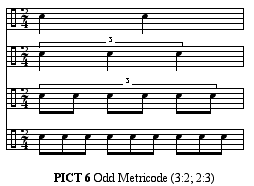
Metricode
In the early 1990’s, Hafez Modirzadeh introduced a concept called METRICODE. Distinct from traditional western meter, Metricodes define Relationships of rhythmic activity to Timeline pulse. Metricode types are Even, Odd, or Random.
Even: in direct relation to the pulse, either by 2 or 3
Odd: in a relation crossing the pulse, such s 3 over 2
Random: no discernable pattern; stream of ever changing patterns