ABOUT
EDUCATION
PROGRAMS
LIBRARY
PUBLICATIONS
THEORY
Please wait while the policy is loaded. If it does not load, please click here to view the policy.

Written by Ellen Goldman, Ann Hutchinson Guest, Peggy Hackney, Richard Haisma, Tara Stepenberg, and Charlotte Wile
[Following is a compilation of discussions originally posted on the CMAlist from June 20, 2010 to July 6, 2010.]
Discussion #1 – From Richard Haisma, June 20, 2010
Hello Labanistas & Barteniephiles,
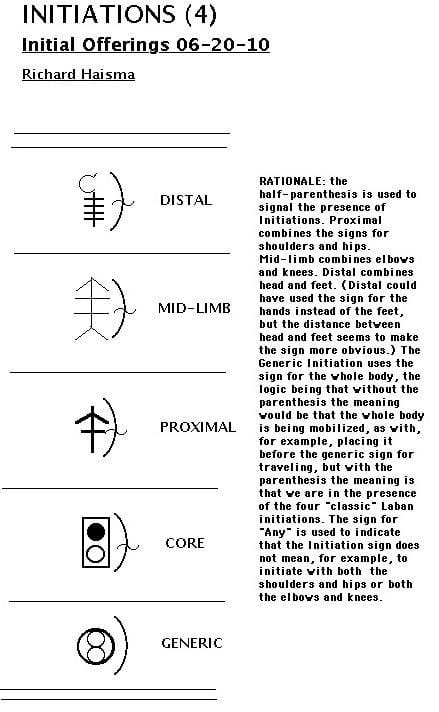
Recently in analyzing some of my choreography and in teaching a class or two on the subject I found the need for symbols for the four classic Laban types of Initiation, that is, Core, Proximal, Mid-limb and Distal, which as far as I know do not presently exist as such. Anybody up for creating some? I’ve started the ball rolling here in the attached files [shown below]. One disadvantage of what I’ve created thus far is probably that some of these simply require too many strokes. If people get interested I’ll shepherd this thru, and maybe if we stay at it we can add to our Motif lore some more.
Discussion #2 – From Peggy Hackney, June 21, 2010
Hi, Richard,
I really like the way you invite the community to respond to your ideas! Thanks.
Peggy
Discussion #3 – From Richard Haisma, June 21, 2010
Hello Peggy (and Rachael) and LMA community,
Two issues seem to have arisen for me immediately:
1] I am unfamiliar with the darkening of the lowest part of the “led by” bow to indicate “Initiated by.” I may very possibly be incorrect here, but I thought that the method we were using in the last 2005-07 Weekend program, under the guidance of Charlotte Wile, was as per the here attached examples that I have created [see below], that is, the initiation bow is simply at the beginning and always of short duration, while the led-by bow can be stretched and the body part which is doing the leading is then placed in the middle of that stretch of time. But I could be wrong, and I certainly don’t want to misrepresent Charlotte. I guess then that my question would be: what problems arise if one uses the type of examples I have here included? What advantages accrue if one darkens the lowest end of the bow to indicate initiation?
I unfortunately do not have the latest edition of Your Move but only that of the 1983 edition third printing of 1995, which, issuing forth not from a LIMS curriculum-orientation, does not deal with the 4 “classic” types of Initiation, and seems in any case, with its emphasis on “led-by”, not to have yet teased out in complete distinction the possible usages of “led-by” versus “initiation.” For example, in that book, on page 155, in Example 126a, what we might now refer to as the shoulder initiating an unspecified action is there referred to as “leading.” And there is no darkening anywhere to indicate initiation. (None of this is criticism, but rather just the search for sources for contemporary usage.) Similarly, in the 2005 uncorrected preliminary draft of Charlotte Wile’s “Moving About,” which was used in the 2005-07 Weekend Program, I find no mention of Initiation or Led-by.
For ideas for proximal, mid-limb and distal indications, see examples 1e-1g in Ann Hutchinson Guest’s November 6, 2006 Theory Bulletin Board posting.
Also see my follow-up to Ann’s posting.
Charlotte
Discussion #5 – From Peggy Hackney, June 21, 2010
Discussion #6 – From Richard Haisma, June 21, 2010
Thank you, Charlotte,
Your two DNB references from 2006 are very interesting.
The suggestion you make for Reach Space seems very usable, and I will be incorporating that into my work immediately.
I do not wish to annoy people on the CMAlist who are not interested in this subject or feel this really ought to be happening instead on the DNB bulletin board. The reasons why I’m pursuing this here is that I think it involves LMA theory (or at least history) as well as Motif Notation. For instance, Ann Guest writes in that November 6, 2006 posting that:
“Kurt Jooss always regretted that Laban, in codifying his Effort analysis, had dropped the factor of central and peripheral use of space and of the body, which had been part of Eukinetics, the quality of movement explored as part of his modern dance training. Because Laban’s focus during the war was on the practical, everyday movements, the expressive content of central and peripheral were not needed. Instead he established the use of space in terms of direct and indirect.”
Well, that is very interesting. Does anyone out there in Labanland know any more about this particular history of central-peripheral space and/or body usage having been part of Eukinetics, or where one could find out more about this? Three questions arise for me:
1] Have we coming through the LIMS LMA curriculum not picked up this Central-Peripheral category that Jooss lamented the loss of with the Space Harmony category of Approach to the Kinesphere, both as Pathway and Spatial Tension, and adding Transverse?
2] Why did Jooss regret that Laban had dropped the central and peripheral use of space and of the body when the category they had been in had been that of Eukinetics which category is about quality and not quantitative spatial or physical usage?
3] The technique and theory of Alwin Nikolais seems to teach Space rather like what Jooss was describing. If Nikolais got his space-time-energy analysis from Hanya Holm and she got it from Wigman, for whom it may have been in the early stages of creation similar to Jooss’ understanding of it, is this why the Nikolais technique and theory, while having contributed so much that is creative and still useful, remains much less rich or fundamental than LMA in terms of its analysis of Space?
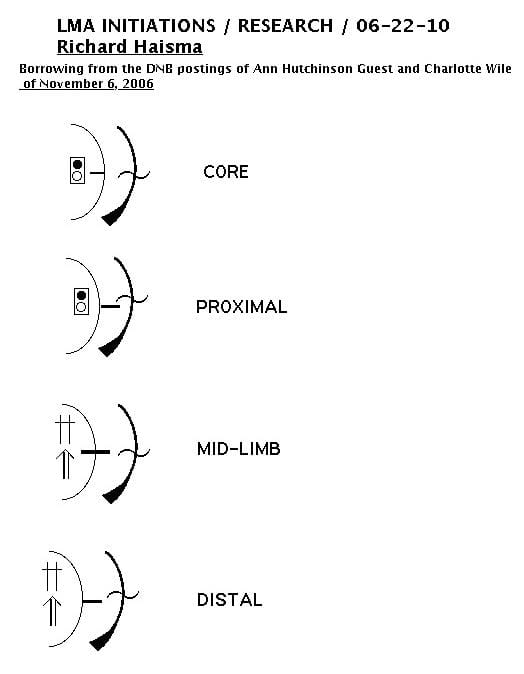
Anyway, be all that as it may, while I do understand the logic of Ann Guest’s “Physically Central and Peripheral”, using those signs to indicate Core, Proximal, Mid-limb and Distal Initiations would seem to present some difficulties, if only again the question of too many strokes.
Here is how am attempting to apply Ann Guest’s essentially elegant and efficient signs to the LMA category of Initiations. Obviously this is way too unwieldy.
Discussion #7 – From Charlotte Wile, June 23, 2010
Hi Richard and everyone,
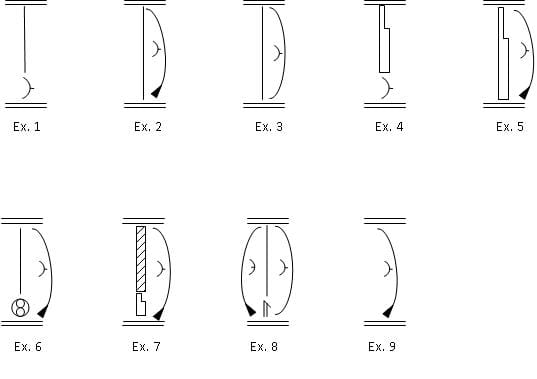
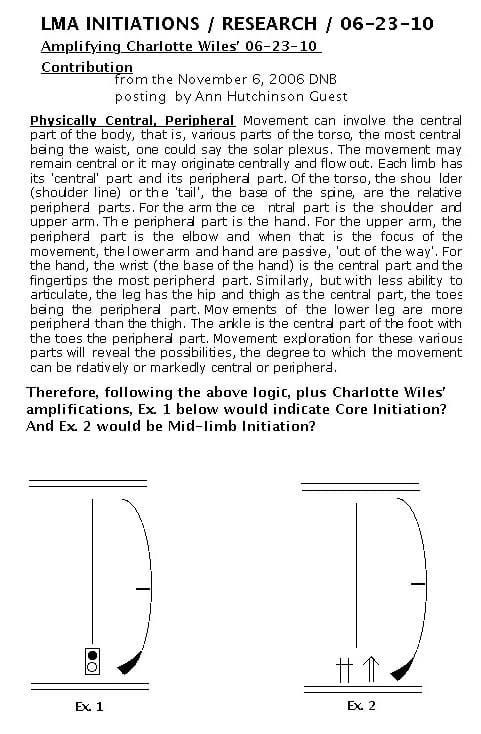
In the examples below I try out some ways to use Ann’s signs. Keep in mind that these are just experiments that may or may not work. Also, please note that my usage is somewhat different from Ann’s in her November 6, 2006 Theory BB posting.
Charlotte
Discussion #8 – From Richard Haisma, June 23, 2010
Best,
Richard
Discussion #9 – From Peggy Hackney, June 23, 2010
Hi, Charlotte and Richard and anyone else who is interested,
Thanks so much, Charlotte for your clear symbols using Ann’s suggested symbols. I can understand Richard’s reticence to give up the terms “Core, Proximal, Mid-limb, Distal” when referencing Initiation (for the reason listed below).
I remember somewhere in the mid 1970s that in the “Effort/Shape” side of the work (Now LMA) we wanted to begin using Body terms for “Initiation” (those terms mentioned above). This meant we stopped the practice, which was current at that time, of using “Central” and “Peripheral” for both the Approach to the Spatial Kinesphere AND for the Body Initiation terms. It was at that point that we also noticed (duh!) that there were Proximal and Mid-Limb initiations as well.
In relation to history, however, I remember teaching a class in Direct and Indirect Space Effort at the State Univ. of New York at Purchase somewhere in the early 1970s. Kurt Jooss happened to be at the school, and watched my class. He remarked that originally what we now call “Direct” was linked with “Central,” and what we now call “Indirect” was linked with “Peripheral.” I feel this is another case of how the system is getting more differentiated.
Any other memories from anyone out there…or suggestions for new symbols?
Discussion #10 – From Richard Haisma, June 24, 2010
Hi Peggy, Charlotte, and Labanistas,
The history of the LMA system you have shared here I find not only personally very interesting but also invaluable. A book ought to be written devoted only to how the system developed and grew over the past century. Such a book should include not only the reasons for the changes and modifications but also the meaning of those changes for ourselves as analysts and for what we are analyzing in movement. Yes, as you say, the system seems to have become more differentiated, and “in the name of what” ought to be a question pasted to our foreheads.
Specifically, tho, that in the mid-70s a shift was made from Central-Peripheral as Body language to the 4 different types of Initiation we have now, well, was that not accompanied with any written theory about it? Why, for example, at that time did we not arrive at Ear, Armpit, Calf or Big Toe types of Initiation? One can initiate anywhere after all. I am not being facetious, since the answer to the question is clearly that Core, Proximal, Mid-limb and Distal all yield such specific results in movement and results which also happen frequently to be such clear connectors or entrances to the other categories of the system such as Effort, Shape and Space. Oughtn’t we have this kind of history and evolution of theory made explicit in a text? I feel we need a lot more unearthing of just the kind of story and history that, Peggy, you have shared with us here.
I do wish we could hear from more people about this little question of symbols for Core, Proximal, Mid-limb and Distal Initiations. Seems not to be exciting imaginations the way the Major Theme symbols did 2 years ago. For me personally when I teach Initiations I feel I am closest to Laban’s feeling for the mystical in movement, since, guiding the students as I do with the idea of a pristine zero from which the Initiation should issue, something coming out of nothing, and from exactly where, gets one pretty close to the PEQ, the Primordial Existential Question, that physicists and cosmologists are now creating lengthy blogs about, that is, “Why Is There Something Rather Than Nothing?” Recently Diane Sawyer on national news interviewed Stephen Hawking. At the end of the interview she asked him if there was one question he wanted to ask of the universe, and he answered with the PEQ. We as dancers and sentient movers probably on a daily, non-verbal basis experience better answers to that question than a thousand bloggers. The symbols, then, that we might find for such experiences function for me as magical talismans.
Discussion #13 – From Peggy Hackney, June 26, 2010
Dear Ann,
It is always wonderful to hear your historical remembrances! Thanks for taking the time to write! Hope you and Ivor are having an excellent summer.
Discussion #14 – From Richard Haisma, June 26, 2010
Thank you very much, Ann. Your perspective is much appreciated, and what you have shared opens doors on our history I did not know existed.
I will want to explore these ideas further.
Richard
Discussion #15 – From Ann Hutchinson Guest, June 27, 2010
Hi, Charlotte and everyone,
Thank you for setting forth these signs. I have one BIG question! How long does an initiation last? Is it not brief? Soon no longer in effect? Shouldn’t the initiation signs be shorter?
A part leading can be of longer or shorter duration, it can continue to the end of the movement, or terminate sooner; the length of the curved vertical bow indicates this timing.
Let me know your thoughts, experiences.
Ann
Discussion #16 – From Charlotte Wile, June 29, 2010
Hi Ann and Everyone:
The timing of the initiation bow is a sticky, but important issue. Here are some thoughts about it.
The timing of initiation was discussed in the minutes for the May 25, 2000 DNB theory meeting, pages 7-8. The relevant section is given below.
Years ago Jane Marriet wanted to be able to show a movement happening first in time and not first in space like leading/guiding. The example demonstrated was a Bartenieff knee drop.
When the DNB was looking for a solution Ann came up with the symbol seen below for the initiation bow (about 1981). Vera Maletic was also using the same symbol but in a very different context (i.e. as impulse).
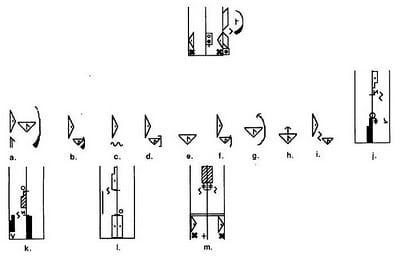
Ex. a. Current DNB usage of initiation bow with shoulder blade initiating.
Ex. b. Addressing the timing issue by placing the initiation as an up beat.
Ex. c. The squiggle indicates that something has to happen before the actual movement.
Ex. d. Using a bracket (an addition bow) to indicate timing.
Ex. e. Shoulder blade
Ex. f. Using a leading bow rather than an initiation bow.
Ex. g. Playing around with the use of an arrow to show initiation.
Ex. h. Similar idea to ex. g but written differently.
Ex. i. Using a zed caret to link the body part initiating to the movement (body part) it is modifying.
*Notators at the DNB have disagreed for many years on the ICKL ruling and continue to use the zed caret as a symbol with a different meaning than a “regular caret” (see last paragraph).
Ex. j. llene said that if we give the zed caret the meaning of leading into a movement then in this example the zed caret doesn’t make sense.
Ex. k. Ann says that in this case this is the primary reason we need zed carets.
Ex. l. You have a very slow preparatory action into the step. In this case it is an unspecified, “natural” way to progress into the movement.
Ex. m. llene wrote this example from the ICKL proceedings and asked if this example would not be equally clear with a caret? It says to shift onto the knees. Valarie and Sandra both said that the shift was the key word. Ann asked how you would do it different without the caret? The response was that you would have to write right forward diagonal high direction symbols.
Ann says that the trouble with blackening one end (see ex. a.) looks too much like an accent. It is possible/probable that the initiation happens before the movement actually begins. You need to show where the movement originates, it may be an unseen part, it may not be that visible, moving in space. A lead by bow is basically a good sign for it, but it needs something else, llene said that the vertical bow is a problem as there are timing issues. Most everyone agreed that the initiating action is almost an upbeat. Valarie thought that we need some sort of pre-sign that could accommodate a body part in it. Patty said that initiating is still denoting movement, action.
The problem with the ICKL ruling on carets and zed carets is that there is NO difference between the meanings in context. The DNB for many years (Ann agrees) has used (and glossarized) the zed caret to link a gesture to a step, to link a head rotation to a facing, and today were exploring the idea of linking a body part to a movement to indicate initiation.
Several ideas for indicating the timing of an initiation were given in the May 25, 2000 excerpt above. Here is another idea:
Initiation is a momentary impetus that occurs at the beginning or just before the beginning of a given movement. (The idea of it occurring before the movement is discussed in the May 25 minutes.) It is assumed that the initiation occurs at or just before the dark end of the initiation bow.
The length of the initiation bow does not show the duration of the initiation. Rather, the length of the initiation bow shows the movement(s) to which the initiation applies.
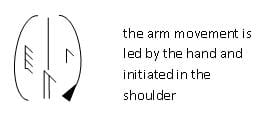
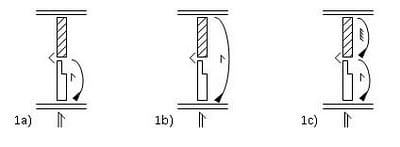
For example, in 1a below, the arm movement forward is initiated by the shoulder. The initiation is a brief impetus that occurs at the beginning or just before the forward movement. This is followed by a separate upward arm movement. An initiation for the upward movement is not given (i.e., it is irrelevant or open to interpretation).
In 1b the arm goes forward, then upward. This whole phrase of movement is initiated in the shoulder. The initiation for the phrase occurs at the beginning or just before the arm goes forward.
In 1c the arm goes forward initiated by the shoulder. Then the arm goes upward initiated by the hand.
Charlotte
Discussion #17 – From Richard Haisma, July 3, 2010
Hello Charlotte,
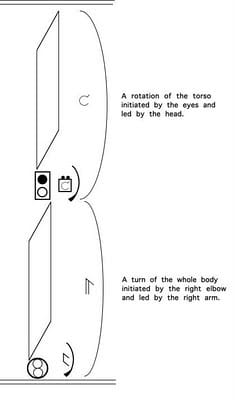
Can you possibly tell me what problems or inadequacies you might anticipate to arise with the following?
Discussion #18 – From Charlotte Wile, July 3, 2010
Hi Richard,
To answer your question, I will refer to the posting I sent to the CMAlist on June 29 [Discussion #16].
I’m assuming that in your notation the length of the initiation bow shows the duration of the initiation. The advantage of this is that the indication of timing is visually clear. It is immediately apparent that the initiation is momentary.
However, as I see it, the disadvantage of having initiation bows always be short is that then they can each only refer to one movement. How could one write that a phrase of movements is initiated?
In [Discussion #16] I suggest one possible solution. Perhaps we could say the length of the initiation bow just shows which unit of movement(s) is being initiated. (The length would not stipulate the duration of the initiation.) This makes it possible to show initiation for a phrase of movements, as in my example 1b. Of course, the disadvantage of my idea is that the momentary character of the initiation is not visually apparent. To make the idea work, the fact that the initiation is momentary needs to be assumed. Or perhaps one could say the duration of the movement is represented by the short, thick bottom part of the bow.
Charlotte
Discussion #19 – From Ellen Goldman, July 4, 2010
Charlotte, to me, the phrasing could be indicated also by the measure, and/or a phrasing bow on the other side of the score. What do you think?
Ellen
Discussion #20 – From Charlotte Wile, July 4, 2010
Hi,
Yes! Keeping the initiation bow short and adding a phrasing bow might be a solution. Is my example below what you mean? Of course that makes the notation more cumbersome. On the other hand, the short duration of the initiation is visually apparent.
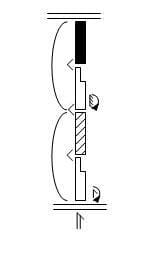
I’m assuming when you say “measure” you are referring to bar lines. I don’t think bar lines would work as well, since they can have various meanings. For example, bar lines might be used to denote measures in music that accompanies the movement. These measures may or may not coincide with a phrase of movement that is initiated. If you wanted to use bar lines to define the boundaries of initiated units, I think that would need to be glossarized.
Charlotte
Discussion #21 – From Ellen Goldman, July 4, 2010
Charlotte, I can see how you are kind of accenting the start of the bow, to show initiation. I like the idea. Works for me.
Ellen
Discussion #22 – From Charlotte Wile, July 4, 2010
Hi,
I would love to take credit for the idea. However, I think Ann Guest came up with it many years ago (in 1981 in the May 25, 2000 DNB theory meeting minutes, p.7)
Charlotte
Discussion #23 – From Tara Stepenberg, July 4, 2010
Hi,
I’m following this on the sidelines – curiosity – i thought that Richard’s motif was indicating initiation and led by (which i did find a bit challenging to execute), as opposed to initiating with a phrasing bow.
Your help is appreciated (and i am enjoying the discussions)
Thanks,
Tara
Discussion #24 – From Charlotte Wile, July 4, 2010
Hi Tara,
I believe the phrasing bow, initiation bow, and part leading bow make different statements:
The phrasing bow is used to show that a series of consecutive symbols have, as Ann Guest says in Labanotation, 4th edition (p. 107), a “unity of thought.”
The initiation bow is used to show the impulse for movement (e.g., a breath), or the place in the body where the movement begins in time.
The part leading bow is used to indicate a body part that that goes first in space.
These bows can be used by themselves or in combination. Examples of various combinations have been presented in these discussions.
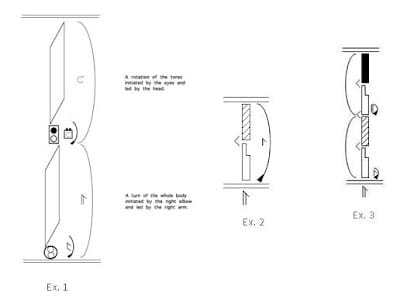
Richard’s notation from his July 3 posting [Discussion #17] shown here in Ex. 1, makes statements about initiation and part leading. It does not say anything about “phrasing” as I have defined it above.
The notation in my June 29 posting [Discussion #16], shown here in Ex. 2, combined the idea of phrasing and initiation into one bow. It does not say anything about part leading.
The notation in my July 4, 2010 posting [Discussion #20], shown here in Ex. 3, made separate statements about phrasing and initiation. It does not say anything about part leading.
It is also possible, of course, to have notation which includes all three: phrasing, initiation, and part leading. You could also have notation that just tells about part leading. But I’m too tired to write examples now.
Discussion #25 – From Tara Stepenberg, July 5, 2010
Thanks
I am “motifingly rusty” – so see that phrasing bows are on the left and body-part leading on the right – yes?
Thanks,
Tara S
Discussion #26 – From Richard Haisma, July 6, 2010
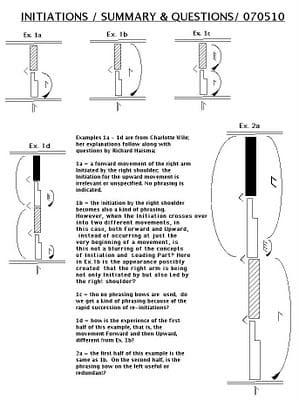
I made a summary diagram with questions. I abandoned my examples in favor of the simplicity of staying with yours with the right arm moving. Nothing dramatic here just clarifying questions.
Discussion #27 – From Charlotte Wile, July 6, 2010
[Responding to Discussion #25]
Hi Tara and Everyone,
As I see it, the placement is optional. The initiation, phrasing, and part leading bows can be placed on either side, depending upon what makes the notation easiest to read.
Charlotte
Discussion #28 – From Charlotte Wile, July 6, 2010
[Responding to Discussion #26]
Hi Richard,
It is quite difficult for me to talk about your comments without being able to physically demonstrate the movement. I will try to respond on line, but this really needs an in-person conversation.
Example 1b doesn’t say anything about part leading. The part that goes first in space would depend upon how you interpret the notation.
Re: 1c The terms “phrase” and “phrasing” have various meanings. Perhaps that is a topic for another conversation. At any rate, just for the purpose of the “Initiation 4” discussion I used the term as meaning that the initiation bow in 1b ties the two direction signs into a “unity of thought.” When you say we get “a kind of phrasing” in 1c, I think you are talking about a different meaning of the term “phrasing”. This is not to say that it would necessarily be wrong to use the term in the way you are implying. But it is not the way I was applying it or the meaning I gave the bow.
As I see it, 1b and the first half of 1d say the same thing. My point was that 1d (which was inspired by Ellen’s suggestion) visually shows the timing of the initiation better, while 1b is less cumbersome.
Your notation in 2a is confusing. I think the indication of timing for initiation bows should be consistent throughout a score. Either use the short bow or the longer bow. But don’t mix the two in the same score. If for some reason you want to use both versions of the bow, I think it would be prudent to explain how they are being used in a glossary. But I personally feel it is clearer to be as consistent as possible.
Also, in 2a the placement of the part leading bow says you start going forward, and then 1/3 of the way into that movement you start leading with the elbow. Just checking to be sure that is what you wanted to say.
Charlotte